Nicotine Patches Work Perfectly. They Just Solve the Wrong Problem

Authored By: Aman Doda
Last Updated: 10/04/2026
Why Nicotine Patches Don't Work for Most Smokers
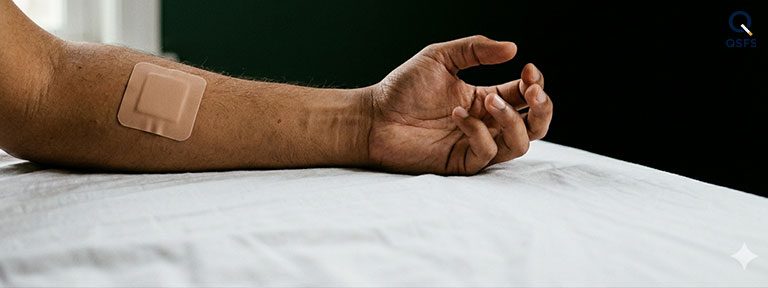
The nicotine patch does exactly what it claims to do. It delivers nicotine through your skin, keeps your blood nicotine levels stable, and removes the physical withdrawal. For the first week — the hardest week — it genuinely helps.
So why do most people who use patches end up smoking again?
What the Patch Actually Does — And What It Cannot Touch
When you smoke, nicotine enters your bloodstream within seconds. Your brain gets a signal. Relief. Reward. Calm. Over years of smoking, your brain learns to expect this — and when nicotine levels drop, it sends signals that feel like restlessness, irritability, and an overwhelming urge to smoke.
The patch addresses this beautifully. It keeps nicotine levels in the blood steady throughout the day. The sharp drops do not happen. The restlessness eases. The physical withdrawal — which peaks around day three and fades by the end of the first week — becomes manageable.
But here is what the patch cannot do. It cannot touch what is in the mind.
Every time you smoked after a meal, your brain recorded that. Every time you lit up during a stressful call, your brain recorded that too. First cigarette of the morning with chai — recorded. Cigarette in the car between meetings — recorded. Step outside after dinner when the family has gone in — recorded. Thousands of times. Over years. Your brain did not just get addicted to nicotine. It built a map. A detailed, deeply wired map of when smoking belongs in your day.
The patch removes the chemical. The map stays exactly where it is.
So the patch goes on. The physical craving eases. And then — three weeks later, or three months later — something happens. A difficult day at work. A social situation. A moment of boredom at 11pm. The map activates. The hand reaches. And the person who was doing so well finds themselves back at square one — wondering what went wrong and whether they are simply someone who cannot quit.
Nothing went wrong. The patch worked. It just was not designed to address the map.
The Numbers That Tell the Real Story
Research published in journals tracking long-term quit rates consistently shows that nicotine replacement therapy — patches, gums, lozenges — has a 6 to 12 month success rate of between 5 and 10 percent when used alone. That means for every 100 people who use a patch to quit, 90 to 95 are back to smoking within a year.
This is not a failure of the people using patches. It is a gap in what the patch was designed to do. Physical dependency and mental dependency are two different problems. The patch was built to solve one of them.
According to the National Cancer Institute, combining nicotine replacement with behavioural support significantly improves quit rates compared to either approach alone. The physical craving and the mental patterns need to be addressed together — not just one without the other.
Why This Matters More for Long-Term Smokers
For someone who has smoked for 10, 15, or 20 years — the mental map is not a collection of a few loose habits. It is a deeply structured part of daily life. Smoking after every meal. Smoking during every break. Smoking as the first and last act of the day. These are not casual associations. They are the architecture of an entire daily routine.
The longer someone has smoked, the more deeply the map is wired — and the more likely it is that a method addressing only the physical side will fall short. This is why so many people in their 40s and 50s, who have genuinely tried to quit multiple times, find themselves back despite their best efforts and despite using every product available.
It is not weakness. It is an incomplete solution being applied to a complete problem.
The Truth About Willpower: Why It’s Not Enough to Quit Smoking(And What Actually Works)
But I Have Tried Before. Why Would This Time Be Different?
Because this time, the right problem is being addressed.
The patch handles week one. That is genuinely useful — getting through the physical withdrawal is hard, and anything that helps with that has real value. But lasting freedom from smoking requires something the patch was never built to provide: a way to dismantle the mental map that tobacco built over years.
QSFS — the Quit Smoking and Nicotine Freedom System — is a 3-week live program built specifically for this. Not instead of managing the physical craving — but addressing what comes after. The patterns. The triggers. The deeply wired responses that send the hand reaching before the mind has even made a decision.
It is for anyone who has tried patches, gums, cold turkey, or willpower — and found themselves back. Not because they did not try hard enough, but because the method was solving the wrong problem. QSFS works on the root — the mental dependence — which is what actually keeps people smoking long after the physical need for nicotine has passed.
People who go through QSFS describe something that surprises them: not just that they stopped smoking, but that they stopped wanting to. The trigger fires and nothing follows it. That shift — from white-knuckling through a craving to simply not feeling the pull — is what makes the difference between quitting for a few months and quitting for life.
Dr Koushik Chaki is a Clinical Cardiologist and Diabetologist who had a heart attack — and still found quitting smoking one of the most difficult things he had ever attempted. He used nicotine patches for a month. He understood the medical consequences better than almost anyone. And he still could not get free using conventional methods alone. He went through the QSFS program, experienced the shift that the patch could not provide, and has been free since. His story is here because it shows, more clearly than any statistic, exactly where patches fall short — and what bridges the gap.
Watch his story in his own words:
Ready to understand what actually works? Join our next free Masterclass — we walk you through the science of why quitting is hard, share real stories from people who got free, and show you exactly what QSFS does differently.
👉 Register for the Free QSFS Masterclass
Spots fill up. If you are ready — do not wait.
Questions People Ask
Patches address the physical withdrawal from nicotine — which is real and genuinely difficult. But physical withdrawal passes within a week. What brings most people back to smoking are the mental patterns built over years — the automatic reach for a cigarette after a meal, during stress, out of habit. These patterns stay in place long after the body has finished with nicotine, and patches were never designed to address them.
Yes — for the first week. Patches keep blood nicotine levels stable, which reduces the sharpness of physical withdrawal and makes the first few days more manageable. The problem is not that patches do not work. It is that they only address half the problem. The physical craving and the mental habit are two different things — and the patch only handles one of them.
Studies consistently show that nicotine replacement therapy alone — including patches — has a long-term success rate of around 5 to 10 percent at 6 to 12 months. That means most people who use patches as their only quit method return to smoking within a year. Combining patches with behavioural support significantly improves outcomes, which is why addressing the mental side of addiction alongside the physical is so important.
Standard patch programs run for 8 to 12 weeks, gradually reducing the nicotine dose. The patch is most useful during the first week when physical withdrawal is strongest. Beyond that, the ongoing urge to smoke is driven less by the body and more by the mental patterns the habit built — and those require a different approach entirely.
A combination approach works significantly better than patches alone. Managing physical withdrawal with a patch or other nicotine replacement during the first week is genuinely useful. What needs to be added — and what most methods leave out — is a structured way to address the mental patterns, triggers, and habitual responses that keep people returning to smoking. This is what QSFS focuses on.
QSFS — the Quit Smoking and Nicotine Freedom System — is a 3-week live program that works on the mental root of smoking addiction. Where patches address the physical craving during the first week, QSFS addresses what comes after — the patterns, triggers, and deeply wired mental map that tobacco built over years. It is for people who have tried patches, gums, or willpower and found themselves back, and who are ready for an approach that works on the real reason quitting is hard.
Yes — and Dr Koushik Chaki’s story shows exactly this. As a cardiologist who had a heart attack, he had every reason and every piece of medical knowledge to quit. He used patches for a month. He still could not get free using conventional methods. This is not unusual — many medical professionals who smoke report the same experience. It is not a question of knowledge or motivation. It is a question of whether the method addresses the right problem.
A Final Word
If you have tried patches and found yourself back — you did not fail. The method was incomplete. The physical side was handled. The mental side was not.
That is what the QSFS Masterclass shows you how to address. Register for the next free session and see exactly what has been missing.
Disclaimer
The content in this article is for educational purposes and is based on widely accepted scientific research on smoking and related health topics. The QSFS (Quit Smoking & Nicotine Freedom System) program is a structured behavioural and psychological support system designed to help individuals address the mental dimensions of nicotine dependence. It is not a medical treatment, does not claim to diagnose or cure any medical condition, and is intended to complement — not replace — professional healthcare. Individuals with existing health conditions are encouraged to keep their healthcare provider informed of any lifestyle changes they undertake. Results and experiences vary from person to person. If you are facing a medical emergency, please seek immediate medical attention.
Share via: