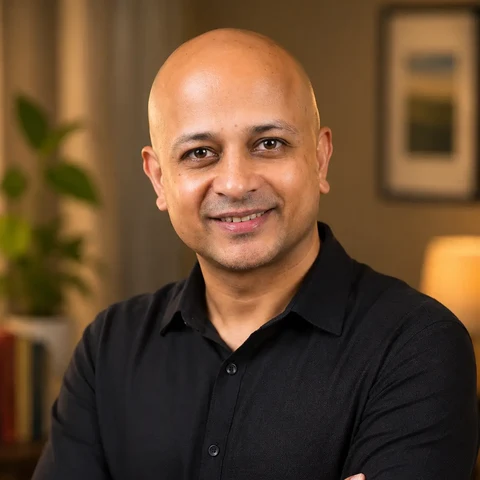
This guide shares general information from my experience working with people who quit smoking. It is not medical advice. If you have chest pain, breathlessness, or any health condition, please see a doctor.
Let me say something you already know. You know smoking is bad. You have read the warning on every pack. You have seen the photo. Maybe your wife, your mother or your child has asked you to stop. Maybe you have promised yourself on a birthday, on New Year, after a bad cough.
And still, the morning chai comes and the hand goes to the packet. A stressful call ends and you are already walking to the tapri. You are not stupid, and you are not weak. If knowledge could stop smoking, every smoker would have quit long ago.
So let me talk to you one-to-one. No lecture, no fear. Let's understand why it is so hard, and what actually works.
Prefer watching? Watch me explain the whole step-by-step method in this video, or read the guide below.
Step 1: Get Your "Why" Clear First
Picture this. You are on the top floor of a 20-storey building and it is on fire. Someone puts a ladder at the window. Will you ask, "How do I climb this?" No. You will find a way, because your reason is that strong.
Quitting works the same way. When your why is strong, the how becomes easier. So sit down and honestly answer: if I keep smoking for the next 3 years, what happens to my health? To my family? To my money? To the kind of person I am?
Write it down. Not to scare yourself, but so that on the hard day, you remember why you started.
Step 2: Understand the Two Parts of the Habit
I call them the chhota shaitaan and the bada shaitaan.
The chhota shaitaan is the chemical part, the body's need for nicotine. Nicotine leaves the body quite fast, which is why you feel restless a few hours after your last cigarette. Once you stop, this part settles. It is the easy part.
The bada shaitaan is the mental part. For years, you have smoked at the same times, in the same places, with the same people: with chai, after lunch, on the drive, on a break, with friends, when tense. Repeated thousands of times, it has become auto-pilot. Your hand goes to the packet before you have even decided.
This is why people stay off for a few days and then go back. The body part was handled. The mind part was never touched.
Step 3: Avoid the 3 Traps That Keep Smokers Stuck
Trap 1: Only willpower
Willpower is your conscious mind. Smoking runs in your subconscious, the same way you drive a car without thinking about the clutch. You can hold with willpower for a few days, but the moment you are tired, stressed or happy at a party, auto-pilot takes over.
Trap 2: Cutting down
"From 15 to 10, then 5." It sounds sensible. But now every cigarette becomes special. You wait for it, you count the hours, you think about smoking more than before. Most people drift back to their old number.
Trap 3: Depending on substitutes
Gums, patches, mints, saunf, a toothpick in the mouth. They may help a little in the moment, but they keep the same routine alive: the hand still reaches, the mind still waits for something. If the root is not changed, the urge simply comes back through another door.
Step 4: Break the Trigger Moments One by One
Write your top 3 smoking moments. For most people in India it is some mix of these:
- Chai-sutta: change the place and the cup. Sit somewhere else, have it with someone who doesn't smoke. Read my guide on breaking the chai-sutta trigger.
- After meals: get up from the table, wash your hands, walk for five minutes.
- Stress at work: the cigarette never solved the problem. It only gave you a break. Take the break, without the cigarette.
- Driving and traffic: clear the car, the dashboard and the glovebox.
- Friends and parties: decide your answer before you go. A simple "Nahi yaar, chhod di" is enough.
Step 5: Use the 3-3-3 Breath When the Urge Comes
When the urge hits, don't fight it with your teeth clenched. Interrupt it. Breathe in for 3 seconds, hold for 3 seconds, breathe out for 3 seconds. Do it 3 times.
The urge is a wave. It rises, peaks and passes. The breath gives your conscious mind a few seconds to take back the steering from auto-pilot.
Step 6: Plan the First Week
- Choose a quit day and tell one person you trust.
- The night before, throw away every packet, lighter and ashtray, from home, office drawer, bag and car.
- Drink more water, sleep on time, and walk a little every day.
- Expect some restlessness, hunger or irritability for a few days. It is temporary. Read what withdrawal feels like.
- If you slip once, don't say "sab khatam". Look at what triggered it and prepare for that moment.
Step 7: Work on the Root, Not the Leaves
Think of a tree in front of your house. If you keep cutting the leaves, they grow back. If you deal with the root, the tree does not come back.
Gums, cutting down and willpower are leaf-cutting. The root is how your mind has connected smoking with relief, focus, stress and company. When that connection changes, you don't feel you are "sacrificing" anything. That is when quitting lasts.
Real Story: Dr. Rajesh Quit After About 29 Years of Smoking
Dr. Rajesh Kashyap smoked for nearly three decades and tried many times before. Listen to him talk honestly about why he kept failing and what finally changed. If you are thinking "can someone like me really do this?", watch this.
"21 days of smoke-free life… it is beyond words to express how happy and proud it feels. Suddenly I have become a superhero for my family and friends — that if I can quit after 29 years, I can do the impossible."
— Dr. Rajesh Kashyap, QSFS participant
Guides for Every Part of Your Journey
- Why you keep relapsing, and how to stop it
- The willpower trap
- How your lungs heal after you quit
- Worried about weight gain? Read this
- Practical tips to quit smoking in India
- Helping someone you love quit smoking
Your Next Step
QSFS, the Quit Smoking & Nicotine Freedom System, is a 21-day online program where we work on both parts together, the body's need and the mental routine, step by step.
If you are serious, join my free live QSFS Masterclass. Register, block two hours, keep the phone aside, and you will leave with a clear plan. You have tried the hard way. Now try the smart way.
Frequently Asked Questions
What is the best way to quit smoking?
Work on both parts of the habit together. The body's need for nicotine settles fairly quickly once you stop. The bigger part is the mental routine: the cigarette tied to chai, stress, the post-lunch break, driving and friends. When you change how your mind reacts to those moments, quitting stops feeling like a daily fight.
Should I cut down slowly or quit at once?
Most people who try to cut down get stuck. Every cigarette you allow becomes more precious, and you end up thinking about smoking all day. It usually works better to choose a quit day, prepare for your main triggers, and stop on that day.
Why do I keep going back to smoking after a few days or weeks?
Because the routine was never changed. The first days are about the body; after that, the old trigger moments come back, chai, a stressful call, a party, and the automatic mind reaches for a cigarette. Going back does not mean you are weak. It means the root cause was not dealt with.
What happens in the first few days after I stop smoking?
Many people feel restless, irritable, hungry or find it hard to focus for a few days. Some cough a little more as the lungs clear. This is a temporary adjustment phase. Water, short walks, sleep and a plan for your trigger moments help. If you have chest pain or breathlessness, please see a doctor.
Can I quit smoking after 20 or 30 years?
Yes. Many people in QSFS smoked for 20 to 30 years. Dr. Rajesh, whose story is on this page, smoked for about 29 years before he quit. The length of the habit makes the routine deeper, not impossible to change.